Portable folding tables can quietly transform a home. They open a dining surface beside the kitchen, support a laptop near a bright window, or create a temporary craft station in a spare room. Their value comes from flexibility, not decoration alone.
If you are wondering where to use portable folding tables in a home, examine unused corners and changing daily routines. A narrow table can serve as a breakfast bar against a wall. In a living room, it can hold snacks during guests’ visits, then disappear behind a sofa. A sturdy six-foot model may support sewing, gift wrapping, or children’s homework. Keep walkways clear, especially near doors and staircases. Measure the folded table before choosing its storage location. That small detail is often forgotten.
Interior planning should remain practical. William Morris, the influential designer and writer, advised, “Have nothing in your houses that you do not know to be useful, or believe to be beautiful.” A folding table should meet that standard through reliable hinges, a stable frame, and an easy-to-clean surface. Check the manufacturer’s weight limit before placing appliances or heavy materials on it. Locking legs matter too. They reduce movement during writing, dining, and home projects.
Still, folding tables are not perfect. Some wobble on uneven floors. Others look more commercial than domestic. I have found that a simple tablecloth can soften the appearance, although it may hide damage or loose hardware. Use the table deliberately, inspect it regularly, and accept that convenience sometimes requires compromise.
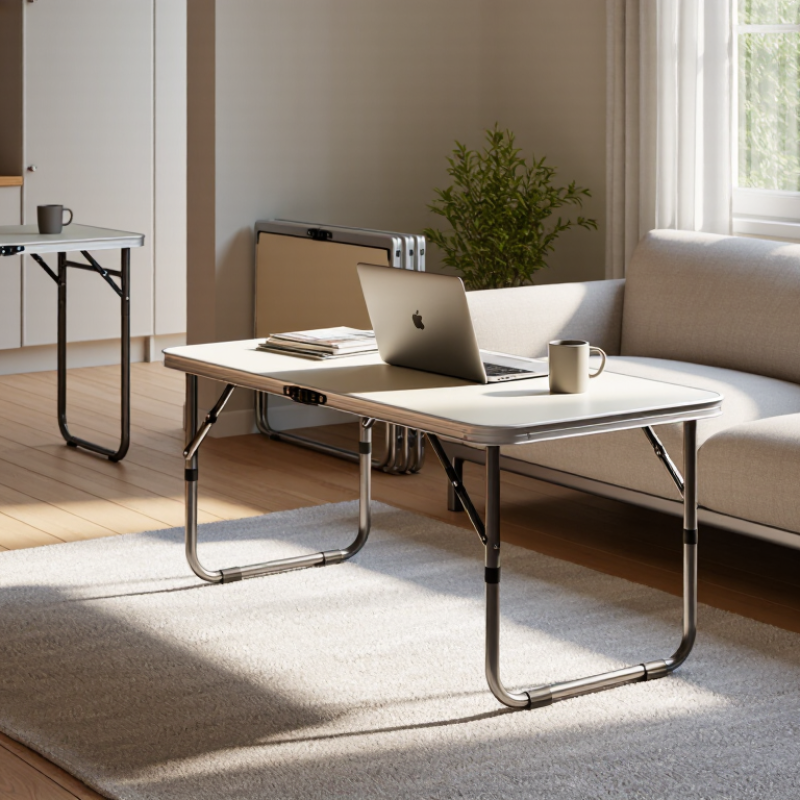
Choose a 4–8 ft table that matches your room and its published load rating. A four-foot table suits a narrow kitchen or balcony. An eight-foot table needs more clearance and stronger handling. Check the label underneath, not only the product page. The rating may separate evenly distributed weight from a concentrated load. A 200-pound rating does not mean one heavy appliance belongs at the center. Spread books, tools, and food across the surface. Keep the table on a level floor. Lock every leg before placing anything on it.
The Consumer Product Safety Commission’s NEISS injury surveillance reports identify falls and struck-by incidents as recurring household injury patterns. That finding matters here. A table can shift when one side carries too much weight. ASTM International guidance for folding tables also emphasizes stable support and proper use. Still, standards do not replace inspection. Look for bent braces, loose hinges, cracked tops, or missing feet. I once treated a small wobble as harmless. It was not. The safer choice is to unload the table and repair or replace it.
Tips: Measure the open footprint first. Leave a clear walking path. Place heavy items low and near the legs, never on the edge. Do not stand, climb, or sit on the tabletop unless the manufacturer expressly permits it. Recheck the rating after adding a tablecloth, storage bins, or a mounted accessory. These details are easy to overlook.
Portable folding tables work best when their surface sits around 29–30 inches high, or 74–76 centimeters. This range suits many home tasks, including laptop work, paperwork, sewing, and light repairs. The U.S. Census Bureau’s 2022 American Community Survey found that 12.7% of employed people usually worked from home, making adaptable household furniture increasingly relevant. However, a familiar height is not automatically ergonomic.
The OSHA Computer Workstations eTool advises keeping elbows close to the body, with forearms roughly level and wrists neutral. At a 29–30 inch table, use a chair that lets your feet rest flat. Your knees should remain near a right angle. Add a firm footrest if the chair becomes too high. For laptop work, raise the screen and use a separate keyboard when possible. Leave about 2–3 inches between your knees and the table’s underside. Small details matter.
In my experience, measuring from the floor to the tabletop prevents a common mistake. I once measured the frame instead. The table felt low after setup. A thick cutting mat can also reduce usable height. Watch for that. The BIFMA G1 ergonomics guideline emphasizes fitting furniture to the user rather than forcing the user into one fixed position. Therefore, test the table for 15 minutes before committing to it. If your shoulders lift or your wrists bend upward, 29–30 inches may need adjustment. A folding table is convenient, but convenience can hide poor fit.
How to Use Portable Folding Tables at Home?
A portable folding table is useful for meals, crafts, laundry, or temporary workspace. Before using it, place the table on a flat, dry floor. Uneven tiles can make the tabletop shift unexpectedly. Open every folding leg completely. Lock all folding legs before placing anything on the surface. Listen for the locking mechanism to click, then test each leg by pressing it gently.
I check the hinges, support braces, screws, and connecting joints before regular use. Look for loose hardware, bent metal, cracked plastic, or unusual movement. A small loose screw can become a larger stability problem. Tighten hardware only as instructed by the table’s manual. Do not force parts that resist movement. Replace damaged components instead of improvising repairs with unsuitable materials.
I once focused on the tabletop and overlooked one partially opened leg. The mistake seemed minor, but the table rocked when I leaned against it. Now I inspect the underside with a flashlight, especially after storage. Dust can hide worn joints and missing fasteners. Keep fingers clear while opening or closing the legs. Avoid sitting on the table or placing heavy objects near one edge. Even after inspection, I sometimes question whether the table is suitable for a particular load, and that hesitation is useful. A stable table should remain steady during light, normal movement.
Portable folding tables are useful for meals, crafts, laundry, and temporary storage. Their safety depends on balanced loading, not just the printed capacity. A 100-pound rating usually assumes a stable setup and an evenly distributed load. It may not support a concentrated 100-pound object placed in one corner.
Place heavier items near the center, directly above the table’s strongest frame points. Keep books, tools, or appliances spread across the surface. Avoid stacking everything beside one leg. That uneven force can twist the tabletop and stress the folding joints. Check that every leg is fully open and each locking mechanism is engaged. The floor matters too. A loose rug can make one leg sit lower.
The U.S. Consumer Product Safety Commission estimated 84,100 emergency-department-treated injuries from furniture tip-overs between 2018 and 2022. That report covers furniture broadly, not folding tables specifically, but it shows why stability deserves attention.
ANSI/BIFMA table-testing standards also evaluate static loads, durability, and structural performance under repeated use. Treat those tests as guidance, not a substitute for the table’s own rating.
I still catch myself adding “just one more box.” That habit is risky. Leave working space around the load, and stay comfortably below the stated limit. A practical target is 70–80% of rated capacity, especially when the table is old, uneven, or repeatedly folded. Inspect cracked plastic, bent braces, loose bolts, and damaged feet before loading it. Some problems appear only after use.
Portable folding tables help with meals, crafts, laundry, and temporary storage. However, their long shape can make lifting harder than expected. The CDC’s National Institute for Occupational Safety and Health sets 51 pounds, or 23 kilograms, as the Recommended Weight Limit under ideal lifting conditions. That figure assumes a stable grip, a close load, limited twisting, and a waist-height starting position. It is not a universal safe maximum. Distance, repetition, balance, and personal strength can lower the practical limit. The Bureau of Labor Statistics also identifies overexertion and bodily reaction among major causes of days-away-from-work injuries. I still catch myself lifting too quickly when guests are waiting. That habit needs correction.
Tips: Check the table’s weight before moving it. Remove objects from the surface. Fold and lock the legs securely. Stand close, bend your knees, and keep your back neutral. Hold the table near its center, not at the far edge. Move slowly through doorways. Ask another adult for help when the table feels awkward, even below 51 pounds. Use a cart for longer distances. Stop if you feel sharp pain, numbness, or sudden weakness.
NIOSH’s Revised Lifting Equation reduces the recommended limit when reaching, twisting, lifting often, or handling uneven loads. A table may weigh 40 pounds, yet still feel unsafe across stairs. Home floors can also be slippery. That detail is easy to overlook. A short practice lift, with the path cleared, often reveals problems before the real move.
Measure the open footprint before buying. A four-foot table suits a narrow kitchen or balcony. An eight-foot table needs more clearance. Check its published load rating underneath.
Not necessarily. The rating may describe evenly distributed weight. Spread books, tools, and food across the surface. Keep heavy items near the legs, never at the edge.
Use a level floor and lock every leg. Leave a clear walking path around it. Inspect braces, hinges, feet, and the tabletop. A small wobble is not harmless.
A surface around 29–30 inches usually suits many home tasks. Keep your elbows near your body and wrists neutral. Your feet should rest flat. Small adjustments help.
Use a firm footrest when your chair is too high. Leave about 2–3 inches between your knees and the underside. Raise the laptop screen and use a separate keyboard when possible.
Yes. Work at it for about 15 minutes. Notice raised shoulders, bent wrists, or pressure behind your knees. I once measured the frame instead of the tabletop. That mistake made the table feel too low.
Remove everything from the surface. Fold and lock the legs securely. Stand close, bend your knees, and keep your back neutral. Hold the table near its center. Move slowly through doorways.
No. The 51-pound recommendation assumes ideal conditions, including a close, balanced load. Stairs, twisting, repetition, and slippery floors reduce practical safety. Ask another adult for help when the table feels awkward. Stop after sharp pain, numbness, or sudden weakness.
Portable folding tables are useful in many areas of the home, including kitchens, home offices, garages, craft rooms, patios, and guest spaces. When deciding where to use portable folding tables in a home, choose a model between 4 and 8 feet long and always follow its published load rating. A height of about 29–30 inches is comfortable for most activities, such as dining, studying, preparing projects, or organizing household items.
Before use, fully open and lock every folding leg, then inspect hinges, braces, and other hardware regularly for damage or looseness. Place heavier items across the tabletop instead of concentrating them in one spot, and keep the total weight below the table’s rated capacity. When moving or setting up the table, lift carefully and avoid carrying more than necessary. As a practical safety reference, follow NIOSH’s recommended weight limit of 51 pounds for lifting, and ask for help with heavier or awkward loads.

Forza Furniture