7 Tips Why Folding Tables Wobble and How to Fix Them?

Time:2026-09-06 Author:Sienna
0%

Why do folding tables wobble and how to fix it is not merely a comfort question. It concerns load safety, user confidence, and product durability. The Business and Institutional Furniture Manufacturers’ Association (BIFMA) identifies stability, strength, and durability as core performance considerations for commercial furniture. Its furniture-testing standards also emphasize repeatable loading and structural evaluation, rather than visual appearance alone.

Market research shows why this matters. Grand View Research estimates that the global folding furniture market will continue expanding as homes, schools, event venues, and workplaces seek flexible space-saving products. More tables mean more uneven floors, loose hinges, worn feet, and rushed setup mistakes. A small height difference can make one leg tap against the floor like a metronome.

Furniture engineer and testing consultant Richard N. Adams explains, “A stable table needs four reliable contact points, not four legs that merely look aligned.” That principle is practical, although real tables can be less predictable. Floor slope, frame tolerance, damaged glides, and uneven weight distribution often interact.

This guide examines seven common causes of folding-table wobble. It covers loose bolts, bent supports, missing foot caps, twisted frames, locking-mechanism failure, uneven flooring, and overloaded surfaces. Each problem needs a different response.

Start with inspection.

Do not simply add cardboard beneath a leg and call the repair finished. That shortcut may hide a damaged joint or shift the table’s center of gravity. Instead, place the table on a hard, level surface, test each contact point, tighten hardware gradually, and replace visibly worn components. The goal is simple: restore even contact, secure locking, and dependable everyday stability.
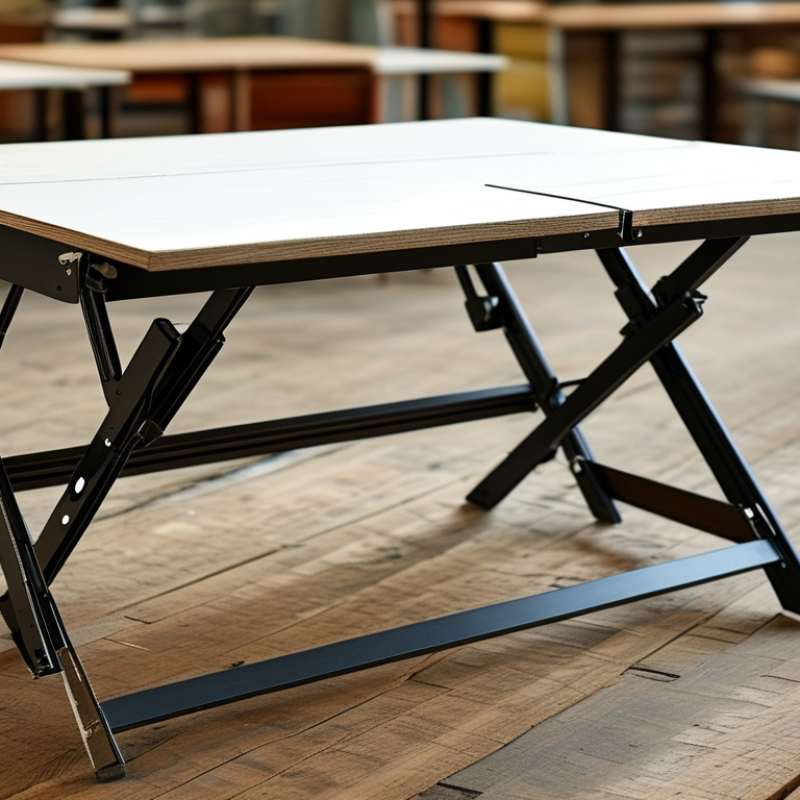
7 Tips Why Folding Tables Wobble and How to Fix Them?

Common Causes: Uneven Legs, Loose Hinges, Floor Gaps, and Overloading

7 Tips Why Folding Tables Wobble and How to Fix Them?

A wobbling folding table usually has a simple mechanical cause. Check the legs on a flat surface, then measure the gap under each foot. Uneven legs are common after repeated folding or rough transport. Adjust the leg locks, tighten visible bolts, and replace damaged foot caps. Do not force a bent leg straight; it may fail under pressure. According to ANSI/BIFMA X5.5, commercial tables are evaluated for stability, strength, and durability, showing why basic inspection matters.

Loose hinges can shift the tabletop by several millimeters. Open the table fully, inspect hinge pins, and tighten fasteners without crushing the frame. Floor gaps also create movement, especially on tile or worn wood. Test the table in its working location, not only in a warehouse. Add a thin, non-slip leveling pad where appropriate. It should stay flat and secure.

A CPSC NEISS report shows why stability checks deserve attention: the system tracks millions of consumer-product emergency visits each year, although it does not isolate folding-table incidents.

Overloading is another frequent mistake. Keep heavy equipment near the center and follow the manufacturer’s load rating. Uneven weight can twist the frame. I once assumed a locked leg was safe, but the hinge still moved slightly. That small error mattered. Recheck every joint before use, especially after relocation, and remove any table that rocks after adjustment.

Measure 28–30-Inch Table Height and Leg Differences in 1/16-Inch Steps

A folding table usually wobbles because its legs do not share the same load. Start with a tape measure. Check the tabletop height at all four corners. Most fixed work tables fall near 28–30 inches, a range referenced in U.S. General Services Administration ergonomic guidance. A difference of only 1/16 inch can create visible rocking on a hard floor.

Use a 1/16-inch ruler or feeler gauge. Measure each leg from the floor contact point to the underside of the tabletop. Record the results, such as 29 7/8, 29 13/16, 29 7/8, and 29 15/16 inches. The shortest leg may explain the movement. I have sometimes blamed the hinge first. That was wrong. Floor slope caused the wobble.

Place the table on its actual floor surface, not a level workshop bench. The Occupational Safety and Health Administration recommends checking workstation stability and surface conditions during ergonomic assessments. Tighten loose fasteners, then inspect locking braces for bent parts or incomplete engagement. Add a thin, firm leveling pad beneath the short leg, matching the measured gap. Do not stack soft cardboard. It compresses unevenly. Recheck the height after placing the intended load, because folding tables can flex under weight. A 1/16-inch correction may be enough, but a damaged leg should be replaced rather than forced straight.

7 Tips: Why Folding Tables Wobble and How to Fix Them

Measure 28–30-inch table height and compare leg differences in precise 1/16-inch steps. A larger height mismatch increases the likelihood of rocking.

The reference range for common folding tables is 28–30 inches. Measure each leg on a level floor, identify the shortest leg, and compare the remaining legs in 1/16-inch increments. Differences of 1/8 inch or more can often be corrected by reseating the leg hinge, tightening hardware, leveling the floor, or adding a non-slip shim.

Fix Seven Wobble Sources: Feet, Braces, Bolts, Hinges, Locks, Tops, and Floors

7 Tips Why Folding Tables Wobble and How to Fix Them?

A folding table usually wobbles for seven practical reasons: feet, braces, bolts, hinges, locks, the tabletop, or the floor. I have repaired tables where one rubber foot was only three millimeters shorter. That tiny gap felt like a rocking chair. Place the table on a flat surface, then press each corner. Replace damaged feet, and adjust threaded levelers evenly. Never compensate for a sloping floor by forcing one leg sideways.

Inspect the braces and folding joints for bends, cracks, or missing pins. Tighten loose bolts with the correct wrench, but avoid crushing plastic parts. Check every hinge for side-to-side movement. A dry hinge may bind and prevent full leg alignment; a small amount of suitable lubricant can help. Confirm that safety locks click completely into position. They should not release when the table receives a light sideways push. According to the U.S. Bureau of Labor Statistics, falls, slips, and trips represented about one-fifth of workplace injury cases involving days away from work in 2022. Stability is not cosmetic.

The tabletop can also twist, especially after moisture exposure or uneven storage. Place a straightedge across it and inspect for gaps. A warped top may require replacement rather than force. I once tightened every bolt before checking the floor; the table still rocked on an uneven tile joint. That mistake was avoidable. Use a thin, firm leveling pad only as a temporary measure. Recheck the table after loading it, because weight can expose a weak brace, loose lock, or uneven leg. Test it again. Safety checks need repetition.

7 Tips Why Folding Tables Wobble and How to Fix Them? - Fix Seven Wobble Sources: Feet, Braces, Bolts, Hinges, Locks, Tops, and Floors
Wobble Source Typical Cause What You May Notice Quick Diagnostic Check Recommended Fix Useful Tools Typical Time Priority
1
Feet
One leg foot is bent, worn, missing, or not contacting the floor evenly. The table rocks diagonally, especially when pressure is applied near one corner. Place the table on a known flat surface and gently press each corner. Inspect the feet for cracks, uneven wear, or looseness.
  • Reposition an adjustable foot if fitted.
  • Replace damaged or missing foot caps.
  • Use a thin, firm leveling pad for minor height differences.
Level, ruler, replacement foot, firm leveling pad 5–15 minutes High
2
Braces
A support strut is bent, disconnected, or unable to hold the leg at its designed angle. The legs move sideways, or the table becomes less stable when lightly pushed. With the table open, inspect each brace connection and compare the left and right leg assemblies for symmetry.
  • Reconnect a detached brace.
  • Tighten its pivot fastener without restricting movement.
  • Replace a visibly bent or cracked brace; do not straighten a severely damaged structural part.
Socket set, screwdriver, pliers, replacement hardware 10–30 minutes High
3
Bolts
Repeated folding and unfolding has loosened fasteners at the legs, brackets, or frame joints. Metal parts shift, clicking or rattling may be heard, and the wobble changes when the frame is touched. Check each accessible fastener by hand, then inspect for missing washers, damaged threads, or elongated holes.
  • Tighten loose fasteners gradually and evenly.
  • Replace missing washers or damaged nuts with compatible hardware.
  • Avoid overtightening, which can crush plastic parts or prevent hinges from moving.
Correct-size wrench, screwdriver, spare washers, thread-check gauge 10–20 minutes High
4
Hinges
A hinge pin is worn, a hinge plate is bent, or debris prevents the folding joint from closing fully. A leg does not open to the same angle as its opposite leg, or the joint has excessive side-to-side play. Fold and unfold the table while observing the hinge. Look for visible gaps, bent plates, corrosion, or movement around the pin.
  • Remove dirt and debris from the joint.
  • Apply a small amount of suitable hinge lubricant if the joint is dry.
  • Replace worn pins or bent hinge assemblies rather than forcing them into alignment.
Brush, cloth, light lubricant, pliers, replacement pin 10–30 minutes Medium
5
Locks
A folding-leg latch, transport lock, or crossbar lock is not fully engaged or is damaged. The table feels stable at first but shifts when someone leans on it or when the frame is moved. Open the table completely and verify that every locking mechanism reaches its stop position and stays engaged without hand pressure.
  • Clear obstructions and fully reset the lock.
  • Tighten a loose lock mount.
  • Replace a latch that does not stay engaged; never rely on tape or a temporary tie for structural support.
Flashlight, screwdriver, wrench, replacement latch 5–20 minutes High
6
Tabletop
The top is warped, a joining seam is raised, or the frame is not mounted evenly beneath the surface. The legs appear level, but objects roll or the top flexes and twists when weight is distributed unevenly. Check the tabletop with a straightedge in both directions. Inspect seams, mounting points, water damage, and loose surface fasteners.
  • Retighten accessible mounting points evenly.
  • Keep the table dry and store it supported in a flat position.
  • Replace a severely warped, cracked, or delaminated top.
Straightedge, level, screwdriver, replacement fasteners 15–45 minutes Medium
7
Floor
The supporting surface is uneven, sloped, soft, or affected by grout lines, thresholds, or floor damage. The table is stable in one location but wobbles after being moved to another area. Rotate the table 180 degrees and test it on a hard, flat surface. Check the floor with a long level or straightedge.
  • Move the table to a flatter location when possible.
  • Use a firm, non-slip leveling shim under the short contact point.
  • Do not use soft, compressible materials that can shift under load.
Long level, straightedge, firm leveling shim, non-slip pad 2–10 minutes Medium

Retighten Hardware to Manufacturer Torque and Replace Damaged Joint Parts

A folding table usually wobbles because its fasteners loosen, legs sit unevenly, or a hinge has worn. Retightening every bolt helps only when the joint remains sound. Check the table on a flat floor first. Press each corner and watch where movement begins. OSHA’s walking-working surface guidance requires stable, orderly surfaces, while the U.S. Bureau of Labor Statistics recorded 211,640 private-industry cases involving falls, slips, and trips in 2022. That figure does not prove a table caused those incidents. It does show why small stability defects deserve attention.

Tip 1: Retighten hardware to the manufacturer’s specified torque. Use a calibrated torque wrench, not guesswork. Over-tightening can crush plastic sleeves or distort metal brackets. Under-tightening allows repeated movement and faster wear. Mark each checked fastener with a small paint line. Reinspect after the next few uses. I would not trust one successful adjustment.

Tip 2: Replace damaged joint parts. Look for oval bolt holes, bent braces, cracked welds, missing washers, and split bushings. Replace the complete hinge or brace when its pivot is loose. Do not compensate with extra washers if the joint no longer aligns. Parts should match the original diameter, thickness, and load path. Relevant furniture testing standards, including ANSI/BIFMA procedures, emphasize repeated loading and joint durability. A table may feel firm during a quick test, yet fail after several folding cycles. Tip 3: Open the table fully, lock both supports, and confirm equal leg contact before placing equipment on it.

Verify Stability with a Centered Load and ANSI/BIFMA Safety Criteria

A folding table usually wobbles for seven practical reasons: uneven feet, loose hinges, worn leg locks, bent tubing, poor floor contact, overloaded edges, or a frame that never fully opens. Start with the floor. Place the table on a hard, level surface, then open every leg until the locking mechanism engages. Check each foot by pressing the tabletop corners. Movement at one corner often reveals a loose fastener or damaged joint.

Test it with a centered load. Use a measured weight, place it directly above the table’s middle, and increase the load gradually. Keep hands clear of folding points. The frame should remain stable without lifting a foot or twisting noticeably.

A centered load is useful, but it is only a screening check. Uneven side loads can expose weaknesses that the center test misses. I once blamed the floor too quickly; the real problem was a slightly bent support rail.

For professional evaluation, compare the table’s construction and test method with applicable ANSI/BIFMA safety and performance criteria. These criteria can address stability, strength, durability, and repeated-use performance, but they do not replace the manufacturer’s instructions or a qualified inspection. Never “fix” a wobble by adding random blocks beneath a leg. Tighten compatible hardware, replace damaged feet, and remove the table from service when locks fail. After repair, repeat the centered-load test and inspect every hinge. Small movement is easy to ignore. That is often the mistake.

FAQS

: Why does a folding table wobble?

: Uneven legs, loose fasteners, worn hinges, or a sloped floor can cause movement. The floor may be the real problem.

How can I measure leg differences accurately?

Use a tape measure, 1/16-inch ruler, or feeler gauge. Measure from each floor contact point to the tabletop underside. Record measurements such as 29 7/8 or 29 15/16 inches.

What table height is common?

Many fixed work tables measure between 28 and 30 inches high. Check all four corners, not just the center. A 1/16-inch difference may cause rocking on hard flooring.

Should I test the table on a workbench?

No. Place it on the floor where you will use it. Floor slopes can disappear on a level bench. I once blamed the hinge first. I was wrong.

How can I correct one short leg?

Place a thin, firm leveling pad beneath the short leg. Match the pad thickness to the measured gap. Avoid soft cardboard because it compresses unevenly.

Is tightening every bolt enough?

Only if the joints remain undamaged and aligned. Use the specified tightening torque when available. A calibrated torque wrench is better than guessing.

Which joint problems require replacement?

Replace parts with oval holes, bent braces, cracked welds, missing washers, or split bushings. A loose pivot may require a complete hinge or brace replacement. Extra washers cannot repair a misaligned joint.

How should I check the table before loading it?

Open the table completely and lock both supports. Press each corner and watch where movement begins. Confirm equal leg contact before adding equipment. Recheck stability after loading. One test is not enough.

Conclusion

Folding tables can become unstable for several practical reasons, including uneven legs, loose hinges, floor gaps, damaged braces, worn locks, and excessive weight. Understanding why do folding tables wobble and how to fix it starts with a careful inspection. Measure the table height, which is commonly around 28–30 inches, and compare leg differences in 1/16-inch increments. Check whether the tabletop is warped or whether the floor itself is uneven before adjusting the frame.

To correct the problem, level or replace worn feet, tighten braces and bolts, secure hinges, and confirm that all locking mechanisms engage fully. Damaged joint components should be replaced rather than forced into position, and hardware should be retightened according to the manufacturer’s recommended torque. After repairs, test the table with a centered, gradually added load. The table should remain level and stable without shifting, while its performance should be reviewed against applicable ANSI/BIFMA safety criteria.

Sienna

Sienna

Sienna is a skilled marketing professional with a deep expertise in our company’s core products and services. With a passion for innovation and detail, she plays a pivotal role in crafting insightful blog posts that not only highlight the unique features of our offerings but also provide valuable......