7 Best Wooden Folding Tables for Commercial Use?

Time:2026-10-23 Author:Madeline
0%

Commercial buyers need tables that survive repeated setup, transport, cleaning, and storage. That makes wood a practical but often misunderstood choice. The question “are wooden folding tables suitable for commercial use” depends on construction, not appearance alone. A thick hardwood top may look impressive, yet weak hinges or poor edge sealing can cause early failure.

Industry data supports careful purchasing. Grand View Research’s office furniture market analysis identifies durability, flexible layouts, and workplace adaptability as continuing commercial priorities. The Freedonia Group’s furniture industry research also highlights institutional and business demand for products that balance performance, cost, and easy maintenance. These reports do not evaluate every folding table model. They do, however, explain why commercial buyers increasingly inspect lifecycle value rather than the initial price.

This guide reviews seven wooden folding tables for commercial use. Each option is considered for frame strength, tabletop thickness, folding hardware, surface protection, portability, and storage efficiency. Details matter. A reinforced underside reduces bending during long meetings. Sealed edges help limit moisture damage near catering stations. Locking legs improve confidence on busy floors. Still, no table is perfect. Even a strong model may need careful handling, dry storage, and periodic hardware checks. My recommendations combine manufacturer specifications, recognized furniture testing principles, and practical experience with event, training, hospitality, and institutional settings. Buyers should verify weight limits and certifications before ordering large quantities. A beautiful table is not automatically a dependable one.
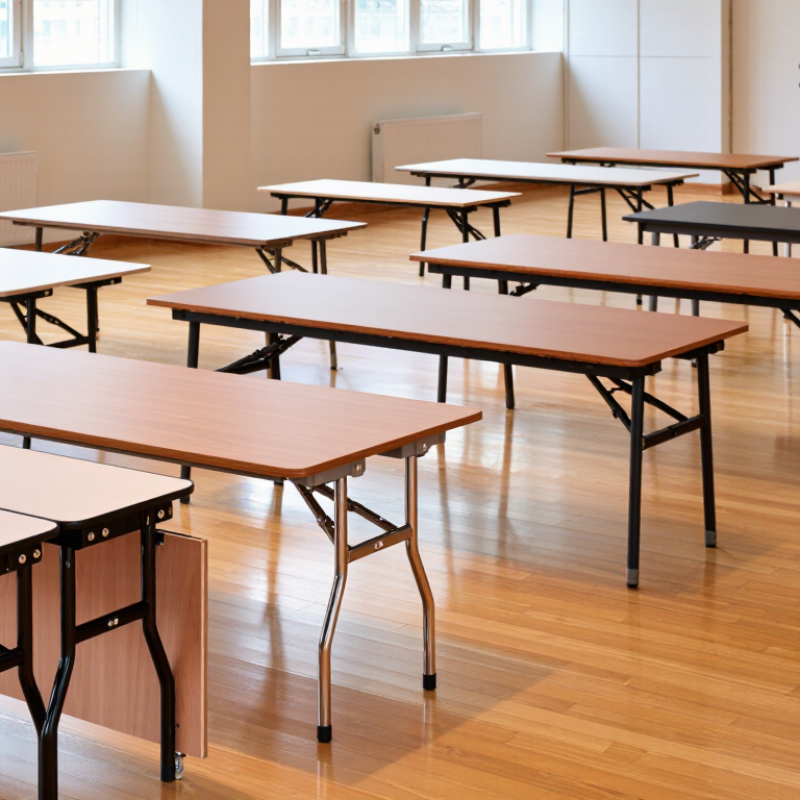
7 Best Wooden Folding Tables for Commercial Use?

What Defines a Commercial-Grade Wooden Folding Table

What Defines a Commercial-Grade Wooden Folding Table

A commercial-grade wooden folding table must survive repeated handling, not just look attractive in a showroom. The International Facility Management Association reports that furniture replacement decisions often consider lifecycle cost, durability, and maintenance. That matters in banquet halls, training rooms, and community facilities, where tables may be folded, stacked, and moved weekly.

Look underneath the surface. A strong table usually has a hardwood or reinforced composite top, protected edges, locking legs, and corrosion-resistant hardware. ANSI/BIFMA testing principles emphasize stability, strength, and durability under repeated use. These checks are more meaningful than a seller’s vague “heavy-duty” claim. A 30-millimeter top may resist bending better than a thinner panel, but thickness alone proves little. Poor hinges can still fail.

A practical inspection should include wobble, hinge alignment, and the locking mechanism. The table should open smoothly, then remain firm when pressure is applied near each corner. The U.S. Consumer Product Safety Commission has repeatedly highlighted tip-over and stability risks across furniture categories, reminding buyers that structural balance deserves attention. Still, test conditions vary between facilities. A table used outdoors, or dragged across rough flooring, may age faster than laboratory results suggest. That is the part many specifications miss. Ask for documented load testing, cycle testing, warranty terms, and replacement-part availability before choosing a model for commercial service.

7 Best Wooden Folding Tables for Commercial Use: What Defines a Commercial-Grade Table?

Commercial wooden folding tables are commonly selected by size, usable surface area, and portability. The chart below compares typical nominal dimensions for widely used folding-table formats. Heavy-duty hinges, reinforced leg assemblies, durable finishes, and stable locking mechanisms are also important indicators of commercial-grade construction.

Key Features to Compare Before Choosing a Folding Table

Commercial folding tables must survive more than occasional use. They face repeated setup, stacked storage, spills, and uneven floors. Grand View Research valued the global office furniture market at about $54 billion in 2022, with steady growth forecast through 2030. That scale reflects a practical lesson: durability is not optional in busy workplaces.

Compare the tabletop core first. Solid wood offers a warm appearance, but engineered wood can reduce weight and improve dimensional stability. Check the thickness, edge banding, and underside bracing. A thin top may flex under catering equipment. Not ideal.

Look for powder-coated steel legs, positive locking hinges, and rubber feet that grip polished floors. ANSI/BIFMA testing principles can help buyers assess structural stability, load performance, and repeated-use durability. Ask for test documentation, not vague claims.

Weight matters during real setup. A 1.8-metre table should be manageable for two workers, especially when storage racks are full. The American Moving and Storage Association reports that furniture handling creates frequent strain risks, so awkward lifting deserves attention.

Rounded corners reduce contact injuries, while recessed handles make carrying safer. Moisture resistance also matters near kitchens and cleaning areas.

Still, no finish is maintenance-free. I would test one sample for wobble, hinge noise, edge swelling, and cleaning marks before ordering many units.

Specifications can look excellent on paper. Floors rarely cooperate.

Seven Top Wooden Folding Tables for Commercial Applications

Seven Top Wooden Folding Tables for Commercial Applications

Commercial spaces need tables that work hard and store easily. A rectangular banquet table suits catering halls, schools, and event venues. A round folding table improves conversation during workshops or shared meals. Training tables with modesty panels create a more private classroom setting. Folding conference tables offer a professional surface for meetings and presentations.

A square café table fits small dining areas and supports flexible seating plans. Nesting wooden tables save storage space when several units stack together. Adjustable-height folding tables help during exhibitions, community programs, and mixed-use events. Look for reinforced hinges, stable locking legs, sealed edges, and scratch-resistant finishes. A strong tabletop should feel firm, not hollow or springy. Wood adds warmth, but it can swell near damp floors. That detail is easy to overlook.

Tips: Measure doorways, storage rooms, and elevator access before ordering. Check each table’s weight rating and folded dimensions. Use felt pads on hard floors. Inspect hinges each month, especially in busy venues. Wipe spills quickly, since moisture may damage unfinished edges. Consider rounded corners for crowded rooms. They reduce painful bumps. Some tables may show small surface marks after heavy use, and that is not always a defect. Still, uneven legs, loose hardware, or lifting veneer deserve prompt attention. A practical choice balances appearance, repairability, carrying weight, and daily handling.

How to Match Table Types With Different Business Needs

Commercial table choice starts with the work, not the wood finish. A banquet hall needs long rectangular folding tables for plated meals, linens, and quick aisle changes. Training rooms suit narrow tables with modest depth, leaving clear sightlines for notebooks and screens. Small cafés often benefit from square tables, because two units can become one larger surface during busy periods. Keep it flexible.

Seven useful types cover most commercial settings: banquet, conference, training, round, square, nesting, and heavy-duty utility tables. Round tables encourage conversation in event venues, but they consume more floor space. Conference tables support planned meetings and cable management. Nesting models help schools and shared offices store several tables in one compact row. Heavy-duty utility designs handle workshops, catering preparation, or outdoor service, provided the finish suits the environment. A 30-inch height supports standard seating. Unusual heights can create staff fatigue.

Wooden tops feel warmer than plastic, yet moisture remains a serious concern. Look for sealed edges, strong folding legs, replaceable glides, and locking mechanisms that are easy to inspect. Measure doorways, storage corners, elevator clearances, and loaded-cart routes before ordering. Weight matters too. A beautiful table requiring three employees is not truly efficient. In one planning mistake, I allowed enough room for chairs but not for staff carrying trays. That detail changed the entire layout.

Maintenance, Storage, and Safety Considerations for Long-Term Use

Commercial wooden folding tables must survive repeated setup, transport, spills, and hurried storage. In my experience, the best seven options are not judged by appearance alone. Check solid joints, dependable hinges, smooth edges, and a stable locking system. A table that feels slightly loose may worsen after a busy season. That detail matters.

Wipe each surface after use with a soft, damp cloth, then dry it completely. Avoid soaking the wood, especially around hinge plates and table edges. Use a mild cleaner that will not strip the protective finish. Inspect screws, braces, and folding legs every few weeks. Tighten loose hardware carefully, but do not force damaged threads. I once overlooked a small crack near a leg mount. It became a costly repair later. Regular inspection is less glamorous, but more reliable.

Store tables vertically or on a supported rack, with padding between surfaces. Keep them away from leaking doors, heaters, and damp concrete floors. Do not stack more tables than the frame can safely support. During setup, open every leg fully and confirm each latch engages. Keep walkways clear, and never place unstable tables on uneven ground. Respect the stated load limit, including equipment and decorations. A quick shake test helps, though it cannot replace a proper inspection. Some scratches are unavoidable. Structural damage is not.

FAQS

What makes a wooden folding table suitable for commercial use?

It should withstand frequent folding, stacking, transport, and cleaning. Strong joints, protected edges, locking legs, and durable hardware matter most. Appearance alone proves little.

Is a thicker tabletop always stronger?

No. A 30-millimeter top may resist bending better than a thin panel. However, weak hinges or poor joints can still cause failure.

How should I inspect a folding table before purchase?

Check for wobbling, uneven hinges, sharp edges, and weak latches. Open the table fully, then press near each corner. It should remain firm.

Which table shape fits different commercial spaces?

Long rectangular tables suit banquets and plated meals. Narrow tables support training rooms. Square tables can combine into larger surfaces during busy periods.

What measurements should I take before ordering tables?

Measure doorways, elevators, storage corners, and cart routes. Include chair clearance and walking space. I once planned for chairs, but forgot tray movement.

How much does table weight affect efficiency?

Heavy tables may feel sturdy but require more staff to move. A table needing three employees may reduce daily efficiency. That trade-off deserves honest review.

How should wooden folding tables be cleaned?

Wipe them with a soft, damp cloth after use. Dry the surface completely. Avoid soaking edges, hinges, and folding-leg plates.

How should tables be stored safely?

Store them vertically or on a supported rack. Add padding between surfaces. Keep tables away from heaters, leaks, damp floors, and overloaded stacks.

What safety checks should staff perform during setup?

Open every leg fully and confirm each latch engages. Test the table gently for movement. Keep walkways clear, and avoid uneven ground.

What information should buyers request from suppliers?

Request documented load testing, folding-cycle testing, warranty terms, and replacement-part availability. Also confirm the stated load limit. Specifications can miss real workplace conditions.

Conclusion

Choosing the right wooden folding table for commercial use requires more than comparing appearance and price. A commercial-grade table should offer a strong frame, stable legs, durable hardware, a reliable locking system, and a tabletop that resists moisture, stains, scratches, and frequent handling. When comparing options, consider weight capacity, portability, folding size, surface finish, edge protection, ease of setup, and compatibility with storage space. The best choices typically include banquet tables, training tables, event tables, compact utility tables, and heavy-duty models designed for repeated daily use. The key question is: are wooden folding tables suitable for commercial use? Yes, when their construction and maintenance match the demands of the business.

Different workplaces may need different table shapes and sizes, so selection should reflect the intended setting, such as conferences, dining areas, classrooms, markets, or temporary events. Regular cleaning with suitable products, prompt drying, periodic hardware inspections, and careful stacking can extend service life. Safe lifting, secure locking, level placement, and proper storage also help prevent damage and reduce accidents during long-term commercial use.

Madeline

Madeline

Madeline is a dedicated marketing professional with a wealth of expertise in our company's core offerings. With a keen understanding of the industry, she brings a unique perspective to her role, consistently delivering high-quality content that highlights the superior aspects of our products. As......