 Forza Furniture
How to Tell If Commercial Grade Folding Chairs Are Worth It?
Commercial venues demand seating that survives more than occasional use. Chairs face repeated folding, daily transport, hurried setup, and uneven storage conditions. That reality makes price alone a poor buying guide. The better question is, why are commercial grade folding chairs worth the investment?
Industry evidence supports closer examination. The Events Industry Council and Oxford Economics reported that business events generated approximately $1.6 trillion in direct global spending in 2022. That activity depends on venues that can prepare safe, consistent seating quickly. Meanwhile, market estimates from Grand View Research place the global folding furniture market in the multi-billion-dollar range, with continued growth expected through the decade. These figures do not prove every premium chair is worthwhile. They do show strong demand for flexible, reusable furniture.
Performance matters more than appearance. A well-built chair usually includes reinforced joints, a stable frame, protective floor glides, and a tested weight capacity. ANSI/BIFMA performance standards can help buyers compare durability and safety claims, although not every folding chair follows the same testing pathway. Check the manufacturer’s test documentation. Ask about cycle testing, replacement parts, corrosion resistance, and warranty coverage. Small details matter when staff move hundreds of chairs across a polished ballroom floor.
The calculation is practical. A cheaper chair may cost less today but require frequent replacement, repairs, or extra labor. That assumption can be wrong. Usage patterns differ widely. A community hall may need different specifications than a convention center. This guide examines cost, lifespan, safety, storage, and maintenance, helping buyers judge value with evidence rather than sales language.
What Defines a Commercial-Grade Folding Chair?
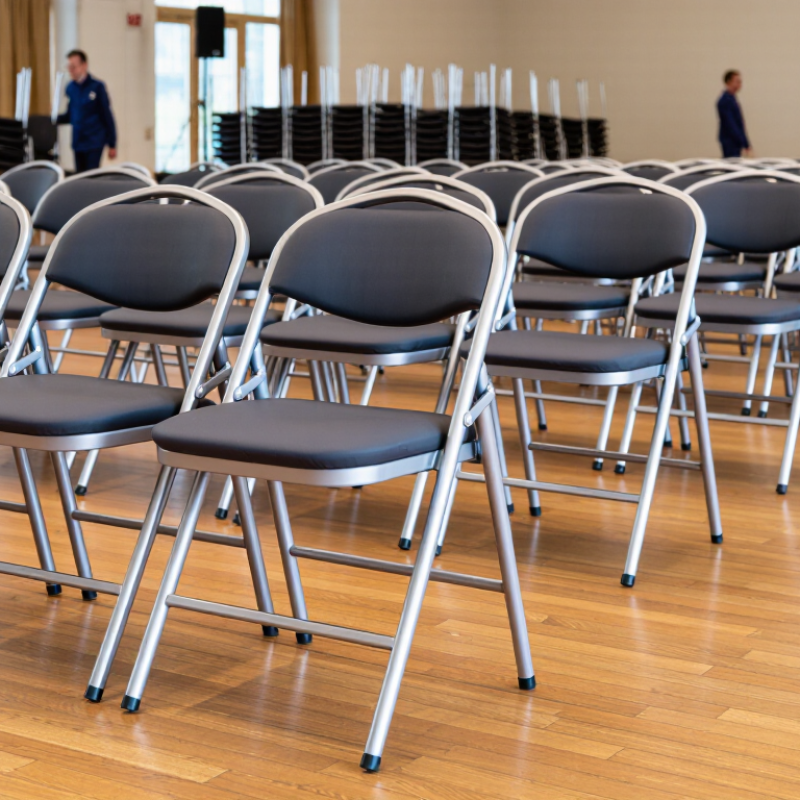
A commercial-grade folding chair is built for repeated public use, not occasional storage in a garage. In venue inspections, I look beyond a thick-looking frame. Steel tubing should feel rigid, with clean welds and no sharp edges. Hinges need controlled movement, not a loose snap. A chair that wobbles on a flat floor is already telling you something. Commercial ratings should come from documented testing and a clearly stated weight capacity. Marketing language alone is weak evidence.
The seat and back also matter. Dense molded plastic or tightly finished plywood can survive frequent cleaning better than thin, brittle material. Check the underside for reinforced attachment points, because screws often loosen there first. Feet should grip without marking polished floors. They should also remain attached after repeated folding. Try opening and closing one chair several times. Feel the frame. Poor alignment becomes obvious quickly. It is a small test, but useful.
For rental halls, classrooms, and event spaces, stack height and repair access affect real operating costs. A practical chair should stack evenly, move without pinched fingers, and allow simple hardware replacement. Certifications may support confidence, but verify the exact model and test scope. I once trusted a heavy chair that later developed hinge play after busy weekly use. Weight was not durability. That mistake changed my checklist: inspect movement, fasteners, finish, and documentation together. Commercial grade is a usage promise, not merely a heavier appearance.
| Evaluation Dimension | Typical Commercial-Grade Folding Chair | Typical Household Folding Chair | What to Check Before Buying |
|---|---|---|---|
| Intended Use | Designed for frequent setup, folding, transport, and use in venues such as meeting rooms, schools, worship spaces, event halls, and training rooms. | Generally intended for occasional indoor use, short gatherings, and lighter handling. | Choose commercial grade when chairs will be used repeatedly by different people or moved and stored often. |
| Load Rating | A commonly advertised rated load is approximately 300–500 lb (136–227 kg), although the exact rating varies by design and test method. | Ratings commonly fall around 200–300 lb (91–136 kg), but some household models may be lower or higher. | Confirm that the rating is documented and determine whether it refers to a static load, a user weight limit, or a tested working load. Never compare ratings without checking the test conditions. |
| Frame Construction | Usually uses tubular steel or reinforced polymer components, with stronger joints, cross-bracing, and reinforced pivot areas intended to withstand repeated folding. | May use lighter tubing, thinner components, or fewer reinforcement points because the expected use frequency is lower. | Inspect welds, rivets, hinge points, leg braces, and the area where the seat attaches to the frame. These are common high-stress locations. |
| Seat and Back Materials | Common materials include impact-resistant polypropylene, molded resin, vinyl, or fabric over a reinforced seat panel. Surfaces are typically selected for easy cleaning and frequent handling. | May use thinner plastic, basic fabric, or lightly padded surfaces that are comfortable but less resistant to intensive use. | Look for a rigid seat base, securely attached upholstery, smooth edges, and materials that tolerate the cleaning products used at the facility. |
| Typical Dimensions | A common chair profile is approximately 17–19 in (43–48 cm) seat height, 16–18 in (41–46 cm) seat width, and 15–18 in (38–46 cm) seat depth. | Dimensions are often similar, but seat width, depth, and back support may be less consistent between models. | Confirm seat height, usable seat width, aisle clearance, and whether the folded dimensions fit the intended storage area. |
| Folding and Storage | Commonly designed for repeated folding and may stack or nest efficiently. Many models weigh approximately 7–12 lb (3.2–5.4 kg). | Often optimized for low purchase cost rather than high-volume transport or compact institutional storage. | Test the folding action, confirm that fingers cannot easily be trapped at pinch points, and measure the required storage height for the planned quantity. |
| Stability and Safety | Should have a stable base, positive leg locks or braces, non-marking feet, and a frame that remains rigid when the user shifts position. | May provide adequate stability for occasional use but can show more movement after repeated folding or uneven-floor use. | Place the chair on a level surface and check for rocking, leg movement, loose hardware, sharp edges, and reliable locking during both use and folding. |
| Surface Protection | Powder-coated metal or other durable finishes are common because they help resist ordinary scuffing, corrosion, and wear. | May use painted or lightly finished metal that can show scratches and finish wear sooner under frequent transport. | Ask about indoor or outdoor suitability, corrosion resistance, cleaning limitations, and whether replacement feet or hardware are available. |
| Durability Evidence | A credible product should have documented performance testing, clear operating limits, and instructions for inspection and maintenance. | Product information may focus mainly on dimensions, appearance, and basic weight capacity rather than repeated-use performance. | Request the test standard or test method, test conditions, cycle information when available, and the definition of the stated load rating. |
| Maintenance and Replacement Parts | Often supported by replaceable feet, glides, hardware, seat components, or other service parts, depending on the design. | Replacement parts may be limited, making repair less practical when a hinge, foot, or seat component fails. | Verify parts availability, cleaning instructions, inspection intervals, and whether damaged chairs can be safely taken out of service. |
| Warranty and Product Support | A warranty of approximately 3–10 years is common in the commercial furniture market, but coverage differs significantly by product and usage conditions. | Warranties are often shorter and may exclude business, rental, institutional, or high-frequency use. | Read exclusions carefully. Confirm whether commercial use, weight limits, upholstery, finish wear, and accidental damage are covered. |
| Total Cost of Ownership | Usually costs more initially but may offer a lower cost per use when it lasts longer, requires fewer replacements, and is easier to maintain. | Lower upfront cost can be attractive for occasional use, but replacement costs may increase when chairs are used frequently. | Compare purchase price, expected service life, repairability, storage efficiency, replacement frequency, and labor required for handling. |
| Best Value Indicator | Usually worthwhile when chairs are used weekly or daily, handled by multiple people, stored in quantity, or required to meet documented safety and durability expectations. | May be sufficient when chairs are used only a few times per year, handled carefully, and stored in a dry, protected location. | Commercial grade is not defined by one feature alone. Evaluate the frame, load rating, safety design, test evidence, warranty, and service support together. |
FAQS
Choose a seat that supports relaxed posture without squeezing the hips. A curved backrest can reduce shoulder tension. Breathable fabric helps limit heat buildup. Test the chair for ten minutes. Brief softness can mislead you.
Check the weight capacity, frame stability, and locking mechanism. The legs should open evenly and stay firm on hard floors. Protective foot caps can reduce slipping and floor marks. Ask whether repeated folding tests were completed.
Smooth hinges make setup, storage, and transport easier. Compact folding saves valuable storage space. A lighter chair helps one person carry several chairs. But very light frames may feel unstable.
Descriptions rarely reveal rattling frames or pinched fingers. They may not show difficult lifting or awkward hinges. Inspect a sample in person. Hands notice problems faster.
Include purchase price, cleaning, repairs, transport, storage, and replacement labor. A cheaper chair may need new hardware after heavy weekly use. Estimate ownership costs over five years. Small labor costs can grow quietly.
Dust can stiffen hinges, while damp storage may encourage corrosion. Inspect loose fasteners, torn upholstery, bent legs, and damaged feet. Use a monthly inspection log during busy seasons. Do not wait for failure.
No. Heavy frames may resist damage but increase lifting strain. They also demand more storage effort. Measure the folded depth and transport distance. Weight becomes an operating cost.
They are useful for frequent events, repeated folding, and demanding transport. Reinforced joints and replaceable glides can extend service life. Compare expected lifespan with replacement frequency. Inspect ten sample chairs before a large order. My assumptions were wrong once.
Conclusion
Commercial-grade folding chairs are designed for frequent use in venues, workplaces, schools, events, and other demanding environments. Unlike basic household models, they typically feature stronger frames, more durable seating materials, reinforced joints, and higher weight capacities. To evaluate their quality, consider construction, stability, corrosion resistance, folding mechanisms, and whether the chair remains easy to carry and store. Comfort and safety also matter: supportive seating, smooth edges, secure locking systems, and reliable non-slip feet can improve the user experience while reducing operational concerns.
The question “why are commercial grade folding chairs worth the investment” is best answered by considering long-term value rather than the initial price. Although they may cost more, durable chairs often withstand repeated setup, transportation, and storage with fewer replacements. Easy-clean surfaces and simple maintenance can further reduce ongoing expenses. They are especially worthwhile for organizations that need dependable seating, consistent performance, and efficient storage over many years.
